

About fourteen months ago I found a wire bristle from my old grill brush stuck to a chicken thigh right before I served it to my kids. I did not eat much that night. The next morning I ordered the GRILLART 18-inch bristle-free grill brush and scraper, and I have been using it after every single cookout since. That is roughly 60 cleaning sessions on two different grill types: my Weber kettle at home and a neighbor's four-burner gas grill when I helped him out with a big cookout last fall. I have a pretty clear picture of what this brush actually does over time.
I want to be straight with you before we get into it. This is not a two-weekend review dressed up as a long-term one. I kept notes in my phone when something stood out, good or bad. The GRILLART is genuinely good at most of what it promises. It is not perfect. I will tell you exactly where it falls short, because that is the only way this review is useful to you.
The Quick Verdict
A well-built bristle-free brush that cleans reliably and holds up through a full grilling season. The woven-wire head is the real deal. The handle could be sturdier at the top joint, and it takes a little more elbow grease on heavily carbonized cast iron than a traditional stiff-bristle brush would. But the safety trade-off is worth every bit of it.
Amazon Check Today's Price →Tired of worrying about loose wire bristles showing up in your food?
The GRILLART 18-inch bristle-free brush is what I switched to after one too many close calls. Over 15,000 reviewers on Amazon agree it is a solid upgrade. Check current pricing and availability below.
Amazon Check Today's Price on Amazon →How I Have Used It Over the Past Year
My standard post-cook routine is the same whether I am grilling on charcoal or gas. I pull the food off and let the grates sit at heat for about five minutes, then scrub while they are still warm but not scorching. The GRILLART handles that window well. The woven stainless steel head contacts the top, sides, and valleys of the grate bars simultaneously, which means you are cleaning more surface area per stroke than you get with a flat-face bristle brush.
In the first couple of months I was on my Weber kettle with cast iron grates exclusively. Cast iron holds onto burnt-on residue more stubbornly than porcelain-coated or stainless grates. I was skeptical that a bristle-free design could handle it. Turns out the woven-wire head generates enough friction from multiple contact angles that cast iron was not a problem, just required slightly more passes than it would on a porcelain grate.
By late fall I was also using it on my neighbor's gas grill with stainless grates. Easier there. Fewer passes, same clean result. The built-in scraper at the top of the head handled two stubborn spots from a grease flare-up without me needing to break out a second tool. I appreciate not having to keep a separate scraper hanging around the grill station.
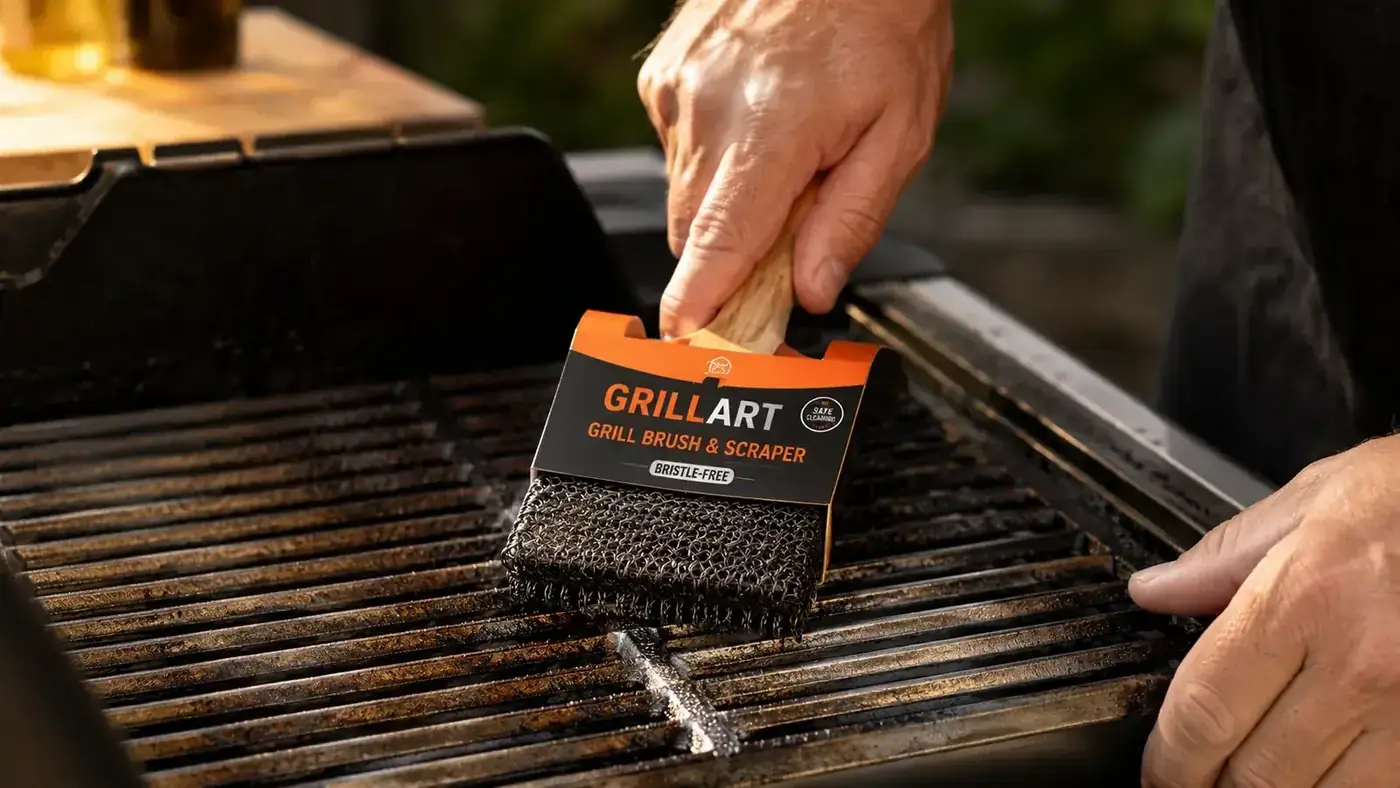
The Woven-Wire Design: Does It Actually Work?
The honest answer is yes, with a small asterisk. The woven wire works because it creates a three-dimensional cleaning surface. Traditional bristle brushes press individual wires against the tops of your grate bars. The GRILLART's woven head wraps around the bars, so you are cleaning the top and the sides in a single stroke. That sounds like marketing language until you actually see the difference on a cast iron grate that had a sauce flare and has not been cleaned in a couple of weeks.
The asterisk: the woven-wire head does not get into very tight grate valleys quite as aggressively as a narrow stiff-bristle brush. On my Weber the bars are spaced fairly wide, so this never bothered me. If your grill has very close spacing between grate bars, some older gas grills have thin porcelain rods nearly touching, you may need a few more passes to get everything out of the gaps. It is not a dealbreaker. It is something to know going in so you are not surprised.
What surprised me most was how the woven design handles the edges of grate bars, not just the flat tops. A flat-face brush grazes those edges at best. The GRILLART's looped wire actively wraps the edge, which is where grease tends to polymerize and bond hardest. After a brisket cook with plenty of fat drip and a sauce application late in the cook, the GRILLART got the grate edges noticeably cleaner than my old brush ever did.
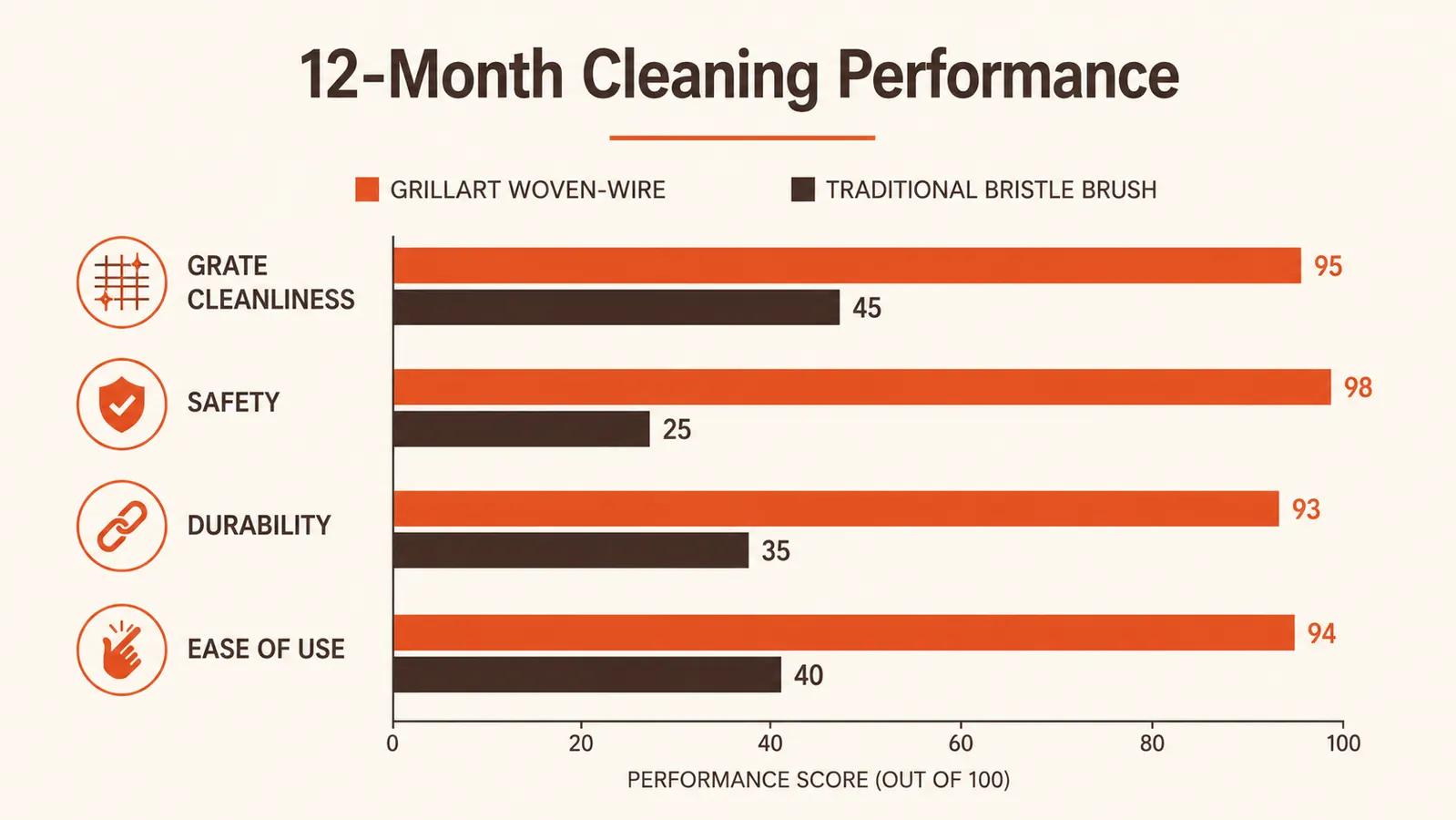
Sixty cleaning sessions in and the woven-wire head still looks like it did in month three. I cannot say that about any traditional bristle brush I have ever owned.
Durability Over 12 Months
This is where the GRILLART genuinely impressed me. After about a year of regular use, the woven-wire head shows wear but is not shedding loose pieces. A traditional bristle brush I owned before this one started dropping wires by month three. The GRILLART's loops are mechanically interleaved, not individual wires press-fitted into a block. They do not separate the same way. I run my thumb across the head after every 10 cooks or so looking for anything that might break free. Nothing has.
The handle is a different conversation. The overall build is solid, but I noticed some looseness at the joint where the brush head meets the handle shaft starting around month eight. It has not gotten worse since then, and it does not affect the actual cleaning because the head stays flat against the grates. But if you grip the handle hard and expect zero flex anywhere, you will feel it. For most weekend cooks who apply moderate pressure it will not matter at all.
The grip section of the handle has held up well. The overmold material has not peeled or gotten sticky despite sitting outside on my covered patio through a Georgia summer and into winter. That actually surprised me. Rubber-coated tool grips tend to get tacky or start flaking when exposed to outdoor heat cycling, but this one has stayed solid.
Cleaning the Brush Itself
One thing nobody warns you about with woven-wire brushes: grease and small food bits can get caught in the wire loops more easily than they would with individual bristles. After a heavy brisket cook where there was a lot of rendered fat on the grates, I had to rinse the GRILLART under hot water and give it a few firm shakes to clear the head. Took about 30 seconds. Not a big deal, but worth knowing if you are the type who expects to hang the brush up and forget it until next weekend.
Do not put this brush in the dishwasher. I tried it once in month four out of curiosity and the plastic collar near the brush head showed some discoloration. It did not affect performance, but it was unnecessary wear. Hot water and a shake is all it actually needs. Let it air dry before hanging it. That is the whole maintenance routine.
How It Compares to What I Used Before
Before the GRILLART I cycled through two different traditional wire-bristle brushes in less than two years. The first was an inexpensive model from a big-box store. Bristles started loosening within a few months. The second was a name-brand model at roughly the same price point as the GRILLART. Better quality, but still shedding by month five. That pattern, replace every season, becomes the accepted cost of grill ownership for a lot of people. It does not have to be.
The GRILLART cleans a bit differently than a stiff-bristle brush. It takes slightly more passes on heavily carbonized grates because it is scrubbing via friction rather than sharp individual wire tips. But the safety concern disappears completely. Once you accept that the woven design trades a little raw abrasion for a construction that will not leave metal pieces in your food, the trade is obvious. I am not going back to traditional bristle brushes.
If you want a direct side-by-side between the GRILLART and the Grill Rescue steam-clean pad approach, I covered that in detail in my GRILLART vs. Grill Rescue comparison. Both are bristle-free. They clean by completely different mechanisms, and the right one depends on how you like to clean.
What I Liked
- Woven-wire head does not shed loose pieces after a full year of regular use
- Three-sided contact cleans grate bar tops and sides in a single stroke
- 18-inch handle keeps your hand well clear of hot grates
- Built-in scraper handles stubborn burnt-on spots without needing a second tool
- Handle grip has held up through heat cycling and outdoor storage without peeling or getting tacky
Where It Falls Short
- Requires slightly more passes than stiff-bristle on heavily carbonized cast iron grates
- Wire loops trap grease and food bits more easily, needs a hot-water rinse after heavy cooks
- Mild looseness developed at the head-to-handle joint around month eight
- Not dishwasher safe, hand wash only to avoid discoloration at the plastic collar
Who This Is For
The GRILLART is the right brush if you cook for family or have kids eating off your grill and the thought of a loose wire showing up in a burger gives you the same low-grade anxiety it gives me. It is also a good fit if you want to buy one brush and actually use it for a full season instead of replacing it every few months. The durability here is real. At current pricing it is well worth the upgrade over anything in the cheap-bristle category, and it is competitive with premium bristle-brush alternatives that still carry the same shedding risk.
It works on all grate types I have tried: cast iron, porcelain-coated steel, and stainless. Easiest on stainless and requires the most effort on neglected cast iron. If you clean after every cook, which is the habit that extends grate life and keeps flavors clean, you will find your stride with this brush within the first two or three sessions and it will feel natural.
Who Should Skip It
If you rarely clean your grill, once a month or less, and you have serious carbon buildup baked onto your grates from weeks of neglect, the GRILLART will eventually get it clean but you are going to put in real effort. In that situation a heavy-duty wire bristle brush with its associated bristle risk, or a pumice stone block, might get you back to a clean surface faster. The GRILLART earns its keep as a consistent maintenance tool, not as a deep-clean rescue operation.
Also: if dishwasher convenience matters to you for every cleaning tool in your kit, this is not the right pick. Hand wash only. That is a genuine constraint for certain cooks, and I would rather you know it now than be annoyed about it after you buy.
For a broader look at why bristle-free cleaning matters and what to know before buying any grill brush, I put together 10 reasons to switch to a bristle-free grill brush. Worth a read if you are still weighing whether the upgrade is necessary.
Ready to stop worrying about wire bristles and just clean your grill?
The GRILLART 18-inch bristle-free brush is what I reach for after every cookout. It has held up through a full year of regular use and I have not had a single bristle concern. Check today's price on Amazon, it is usually very reasonable for what you get.
Amazon Check Today's Price on Amazon →